Black carpenter ants (Camponotus pennsylvanicus) excavate wood galleries rather than consuming timber, leaving behind distinctive piles of coarse sawdust mixed with insect body fragments, known as frass. In older…
Black carpenter ants (Camponotus pennsylvanicus) excavate wood galleries rather than consuming timber, leaving behind distinctive piles of coarse sawdust mixed with insect body fragments, known as frass. In older Springfield housing stock across McKnight, Forest Park, and Liberty Heights, late-nineteenth-century balloon framing and settled sill plates frequently absorb rainwater or plumbing condensation, creating prime nesting conditions. Satellite colonies establish themselves inside hollow door cores, wall cavities near leaking dishwashers, or insulated roof eaves, while the parent colony remains outside in decaying tree stumps or old landscape ties. Single-story ranches in East Forest Park and Pine Point experience similar nesting in ground-contact porch supports and framing adjacent to shaded gutters.
Remediation uses scientific Integrated Pest Management (IPM) rather than broad-spectrum repellent sprays. Standard retail surface sprays scatter foraging workers, causing a colony to bud into multiple hidden sub-colonies throughout adjacent walls. Professional protocols introduce non-repellent liquid treatments containing active ingredients such as fipronil along structural entry thresholds, paired with specialized abamectin or indoxacarb gel baits. Foragers cross these invisible residue zones without alarm, transferring the compound back into the deep gallery network to neutralize the egg-laying queen within 14 to 30 days.
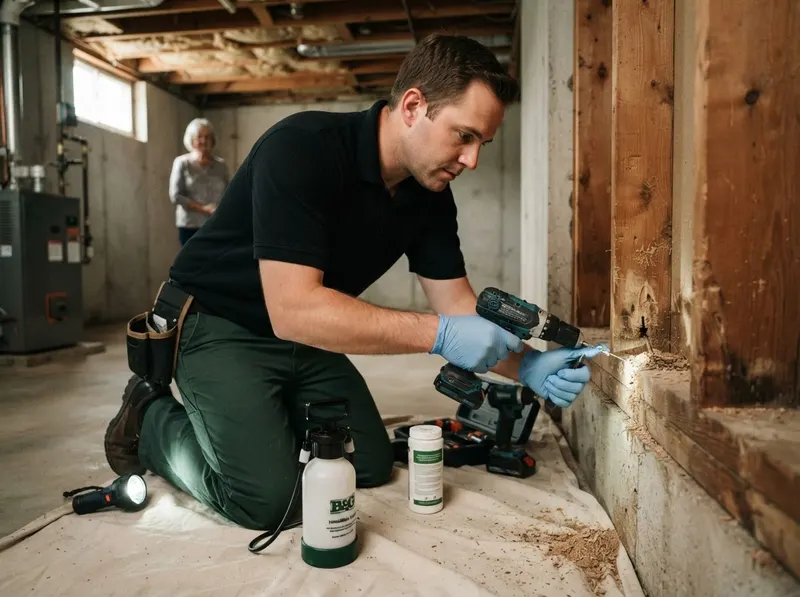
Selecting localized spot treatments suits isolated satellite colonies inside accessible porch framing, but full structural protection is required when winged swarmers emerge inside interior living areas. Winged reproductives indicate an established primary or secondary nest that has matured for over three years inside the framing envelope. Orevian Pest Solutions performs exterior perimeter banding around foundations and drills precise 1/8-inch access points into identified wall voids for targeted aerosolized dust applications, avoiding broad wall removal. The trade-off between exterior perimeter barriers and internal void injections hinges on nest location: treating only the outdoor foundation leaves interior queens unaffected, while treating only indoor voids allows outdoor parent colonies to continuously restock indoor satellite outposts.
Every job gets a firm, written price after a free on-site visit.
Tell us about your carpenter ant remediation job in Springfield and we'll send a clear, written quote, usually the same day.
 Orevian Pest Solutions